Houston Sprinkler System Terms & Definitions
Sprinkler System Basic Terms & Definitions
Texas Licensed Irrigator #4846
- Controller - a clock that activates the start or the watering cycle at preset times, and on preset days.
The clock is the brain of the system. It is usually mounted in the garage in a convenient location. There are several types of controllers: Electro-Mechanical, Hydraulic, Electronic Hybrid Controllers. - Electro Mechanical Controllers usually involve pins/buttons or knobs to push in or out. These knobs control start times, station run times, etc. (Less programmer friendly).
- Hydraulic Controllers are less frequently used; however, there are still quite a few in use. These controllers activate valves by water pressure "Hydraulically" through plastic tubing that is run to each valve.
- It is difficult to find these yard valves for repairs due to no existing electrical wire to trace to the valves. (These controllers are not user or repair friendly).
- Electronic Hybrid Controllers - "Rainbird" Series is by far the most popular controller "programmable and user friendly". For instance, the Rainbird ESP "E" Series.
- 9-Zone Controller has extra-simple programming features that include: Water Budgeting
- Precise station timing in 1 minute increments
- Programmable day-of-week watering schedule
- Independent dual programming
- Self-prompting alphanumeric liquid crystal display (LCD)
- Master valve/remote pump start circuit
- Manual start & station advance
- Custom & Fixed programming schedule 2, 3 or 5-day fixed or 7-day customized schedules
- Automatic starts - 6 start times per program
- 3 programs A,B,C
- Valves - two common types of valves: Manual valves - you turn on by hand or special tool. Electric Remote - control valves electronically activated by the controller "clock" in garage.
- Manual valves are rarely used anymore and are more frequently converted to electrical valves.
- Electric valves are what control the flow of water, the "gatekeeper". When the controller "clock" sends a signal to the valve, the valve opens and allows water to flow into the piping of a specific area or "zone", i.e. the front flowerbed or vegetable garden area, etc.
- Electric valves are available in different sizes and materials. Plastic and brass 3/4", 1", and 1-1/2" etc.
- Plastic is the most common for residential & light commercial use.
- Zone - a section of your yard controlled by a valve, i.e. a zone could be the turf in the front yard, another zone could be the front entry flowerbeds, etc.
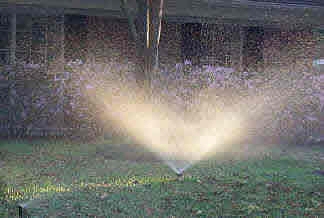
- Pop-Up Spray Heads - these are the water delivery devices that spray the water into a flower bed or lawn area. They come in various sizes - 2", 3", 4", 6", and 12". These heads are buried below ground and pop-up above ground when a zone or valve is activated by the controller. These heads are generally used for irregular bed and turf areas where a precise amount of water is needed. Typical spacing is 12' - 15' on centers - triangular spacing. 4", 6", and 12" Pop-up sprays are most commonly used.
We prefer "Rainbird" pop-ups that feature matched precipitation rates: - Ratcheting Stem (for adjustments of spray)
- Pressure activated wiper seal
- Plastic & stainless steel materials
- Stainless steel retract spring
- Fully-adjustable flow
- Under the nozzle filter screen
- Nozzles - we use "Rainbird" Pop-up sprays & nozzles.
Nozzles come in various sizes and are usually plastic. Some nozzles have a fixed spray pattern. Some are adjustable "Van" variable arc nozzles. "Rainbird" nozzles screw onto the pop-up head or stem. They control the amount and spray pattern of the water sprayed, i.e. a fixed 15' half spray nozzle will typically spray a 15' radius and deliver 1.85 GPM of water in 180° pattern or "half moon pattern".
Variable Arc Nozzles will allow you to adjust the spray arc or pattern by twisting the collar to the desired position. Best used for curved bed and turf areas.
Brass Nozzles are less frequently used. They are a step up from plastic nozzles. They are longer lived, more expensive, a little bit more precise in their water delivery. Plastic nozzles are most commonly used and work great!
Rotary Sprays - there are two typical types of rotary pop-up sprinkler heads: Impact & Gear Driven.
Rotary Sprinklers are most commonly used in large turf areas. They can spray anywhere from 30' to 200' and are more suitable for large open areas.
Rotary Sprinklers are more economical due to the fact that you can space the heads further apart & cover more area with fewer heads & piping.
Impact Rotaries employ a weighted, spring-loaded drive arm to deliver the force to rotate the nozzle assembly. The sprinkler system deflects the arm sideways and the spring pulls the arm back to the nozzle assembly and into the path of the system. As the drive arm completes each swing cycle, it impacts against the nozzle assembly, rotating it slightly.
Gear Driven Rotary Heads provide a consistent powerful rotation to the sprinkling streams. Water under pressure enters the base of the head through a diffuser that converts into high velocity jets. These jets are then impinged against a turbine-like rotor causing it to spin at extremely high speeds. A gear train, driven by the rotor, reduces the high rotational speed and converts it into a strong turning torque. This torque gives the nozzle assembly the relative slow rotational speed necessary for good coverage.
Gear Driven Rotary Heads are our preference. They are extremely dependable and hold up to the rugged demands of commercial projects. These rotaries should provide many years of trouble free watering for residential use. We prefer "HUNTER" PGP Rotary Heads.
Pressure Vacuum Breaker - this device is required by most cities and protects the city's water supply and the home owners water supply from contaminants that could back siphon through a low sprinkler head that is sitting in a puddle of dirty water contaminated with fertilizers and various other run-off wastes.
Back-flow due to siphonage, negative or sub-atmospheric pressures in a city distribution system can be caused by main breaks, planned or emergency shutdowns, fire demands, etc.
Make sure you get a good quality brass vacuum breaker installed, i.e. FEBCO 765-1" Brass PVB. - Flex Pipe (Funny Pipe - a flexible pipe usually ½" in diameter that is used for swing joints on pop-up spray heads and rotaries.
This pipe allows the head to flex or give when run over by a heavy object. Especially effective by driveways.
Class PVC Pipe - SDR-PR PVC Pipe is usually used for sprinkler system piping and is preferred because of the uniform pressure ratings.
Schedule 40 PVC Pipe - has greater pressure ratings than SDR-PR type in sizes 1½" and smaller. Some cities require Schedule 40 for the entire main line, or from the meter to the PVB device. There are a few cities that require the entire system to be Schedule 40. This can drive the sprinkler system cost up.
Direct Burial Wire - Type UF is the most common wire recommended for value circuit (direct burial) wiring. Type UF is moisture proof and resistant to practically all chemicals normally found in earth. The heavier insulation of Type UF offers greater protection.
Risers - piping that stands permanently out of the ground offering even water distribution above taller shrubs, typically placed against the foundation of homes & in the center of large beds. Usually made out of Schedule 80 gray PVC, occasionally copper is used for better appearance.
Ball Valve - usually located by your meter in a valve box. This valve is manually operated (by hand) when it is necessary to turn off the sprinkler water supply for repairs or freezing weather.
Valve Boxes are boxes that enclose the underground valves in your yard. These boxes allow the irrigator to access the valves in the event of a repair.
- Common Contractor Shortcuts
- Helpful Tips When Selecting A Contractor
- Frequently Asked Questions
- Points To Remember
- Terms And Definitions
- Watering Schedule
- Winterizing Sprinkler System
- Drip Irrigation
- Sprinkler System Options
- Pressure Vacuum Breaker Inspections
- Sprinkler System Basic Troubleshooting
- Upgrade Existing Sprinkler System